A 30% discount needs a 233% lift
It's mid-October, and most Q4 plans are probably final already, but there's one piece of math worth running while you can still make adjustments, because you need to know how much more volume you have to drive for discounting to be productive.
The breakeven math
Say you sell a $100 item at a 60% gross margin, so $40 of cost in every unit, and you spend 30% of your collected revenue on ads. At full price, every unit you sell collects $30 of contribution, that's the $100, minus $40 of goods, minus $30 of ads.
If you run a 30% discount, the item sells for $70, the goods still cost $40, and if your ad spend holds steady at 30% of revenue, that's $21, so every unit now collects $9. To bring in the same dollars you would have collected anyway, you need 3.33 times the units. That's a 233% lift just to break even.
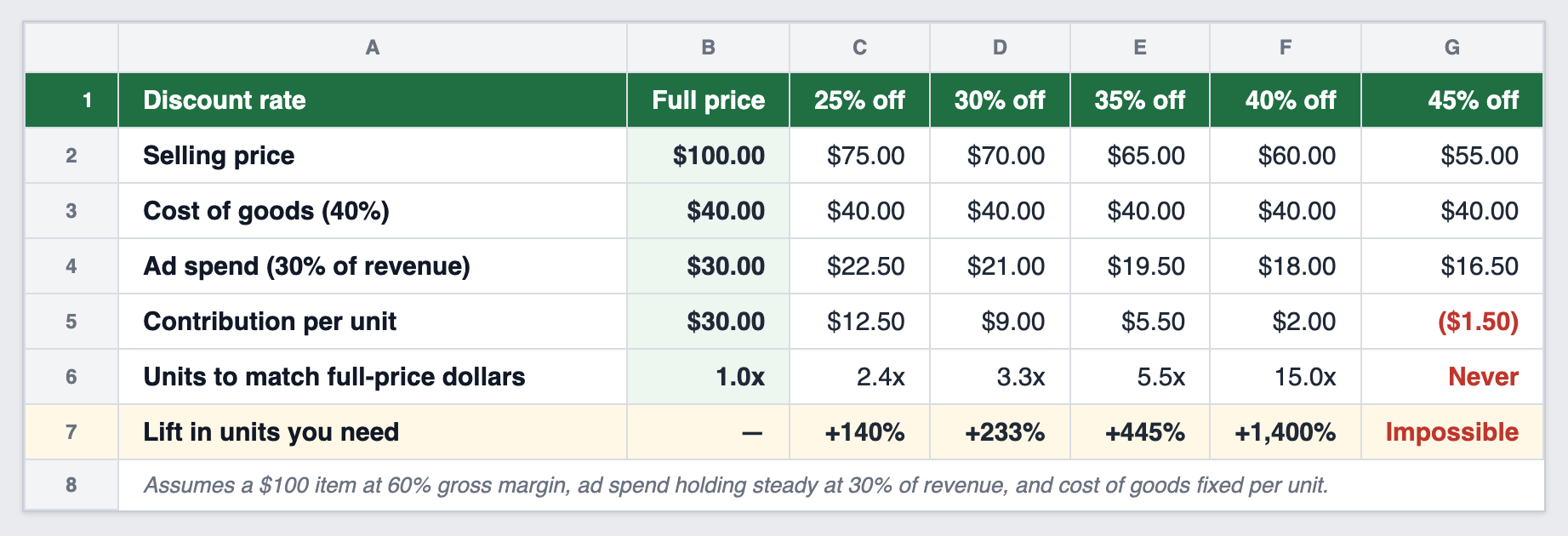
The math is compounding. At 25% off you need a 140% lift, at 30% you need 233%, at 35% you need 445%, and at 40% you need 1,400%. At 45% off, this business loses money on every unit, so there is no lift that saves it. That's the same thing I wrote about in the squeeze, when things get tighter, they're exponentially tighter.
Volume hides the problem
If you discount 30% and get a 200% lift, the week feels good from a strictly topline perspective, volume is up, everybody's high-fiving, and you collected fewer dollars than if you'd done nothing. Your contribution margin, your real dollars collected, didn't offset the discount rate. Most marketers and leaders and CEOs aren't taking this into account, everybody's driving the topline number and kind of ignoring everything underneath, because the volume is high enough that the overall business looks better while the margin compresses.
Even if that works in 2026, you've created a bigger problem in '27, and if you defer '27's problem to '28, it's larger again, and so on until it doesn't work.
This isn't anti-promo
This isn't anti-promo, it's anti-reckless promotion. We pull the discount lever hard ourselves in Q4, inside one tight window that gets planned before the season starts. People default to bigger offer is better, and that might be true sometimes. The point is that the required lift is how you choose your depth, because a deeper offer that can't clear its own breakeven is cutting your legs out from under you.
There are caveats worth naming. The math assumes ad spend holds steady as a percentage of revenue, and if the discount makes your spend more efficient and that percentage drops, the math moves. In the 30% scenario, ads falling from 30% of revenue to 15% means each unit collects $19.50 instead of $9, and the breakeven lift drops from 233% to about 54%, so a discount can be profitable at much lower lifts. The catch is that if you're running deep discounts, your team usually doesn't have the discipline to all of a sudden run leaner on ads, and your conversion rate doesn't hold either, so the relative performance stops working over time. Run it with the ratio you actually expect.
The other reasons discounting at worse contribution can make sense are usually covering for a different problem, fixed costs your true demand can't support, or inventory you overbought. Those are problems to go fix.
There's one more argument you'll hear, that promo buyers are new customers and the future value makes up for the thin math today. I've written about that one. Betting on projected future value to rescue weak first-order economics is the most expensive lie in e-commerce.
Run yours
Divide your full-price contribution per unit by your discounted contribution per unit, and that multiple is the volume you need just to break even. Run it with your true metrics, your margin, your ad ratio, the depth you're planning, and start there. If the offer you've penciled in for Q4 can't clear its own number, there's still time to change it. You're not locked in yet.