Pick the growth number last
It's annual planning season, and most revenue plans I've seen start with the aspirational topline number. Somebody decides we're doing $40 million next year, and the whole plan gets built to make that true. That's the most common mistake I see.
Start from the run rate
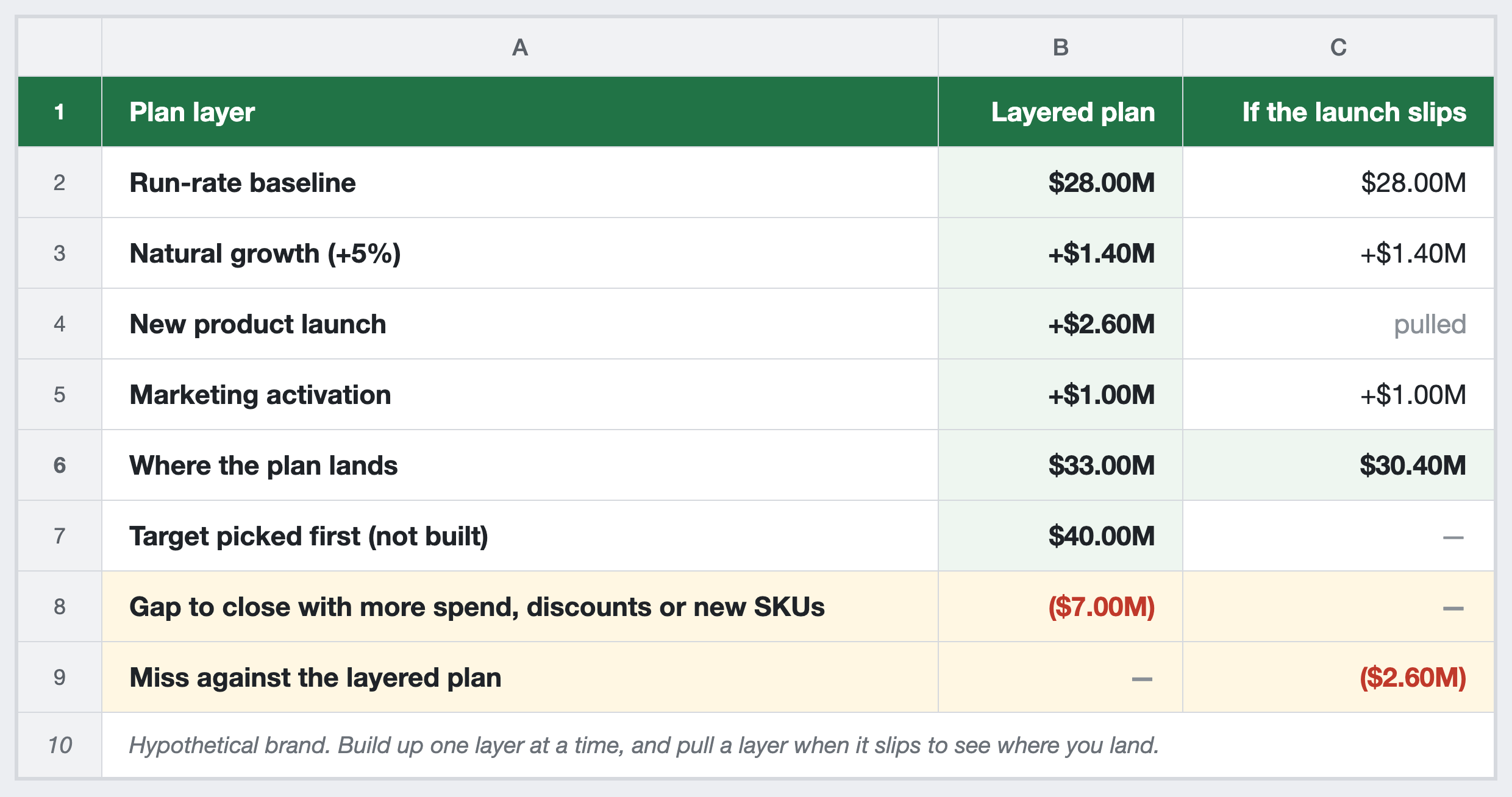
Instead, start with your current run rate as the baseline, basically what you'd do over a full year at the pace you're selling today. Then you add the natural growth you expect, what the business would grow on its own before anything new. On top of that you layer in product launches, marketing activations like a big campaign, whatever else you think will drive some lift year over year. What you end up with is a layered forecast, where each activity sits on top of the baseline as its own line, so you can pull activities out or add them in.
I think the natural growth rate is where being in the business every day gives you context. Last year's trend helps a lot, and if your category is growing, that should factor in. If you've been losing market share, planning on suddenly outperforming the market is probably a bad call.
Every sales channel gets its own revenue number and its own owner, but they're all driven by the same thing, more demand. So we basically ask where we think demand for each product category is headed, and the plan builds up from there.
What picking the number first costs
If you decide you're doing $40 million and work backward from there, bias creeps into your assumptions because they have to add up to that number, and you spend the year stretching to make it work. That shows up as cost pressure, missed targets, whatever it ends up being.
Say you plan for $40 million, so you order inventory to sell $40 million and get ready operationally, but maybe your true demand is only $33 million, which is where the layers land for this made-up brand in the table below. Now to find that extra $7 million you have to spend more, discount, or rush out new SKUs, and it gets expensive.
Closing the gap
If there's a gap between where your layers land and the number you want, there are a few ways to close it, and each one costs something different. I think the most sustainable ones are driving new demand and launching new product. They're the better long-term plays, but they're riskier and slower to pay off. New product takes time, you're not turning that around in a month, and new demand is a bet.
New sales channels or price changes work almost right away, but in my mind they're short-term pops that don't last without demand growth. It depends on your category and all these other things.
One growth rate all year rarely works
We used to plan the same growth rate for every month of the year, and it almost never plays out that way. Even when you're building demand and launching product, the year has a lot of ups and downs, and a plan that's too smooth gives you heartburn when the year doesn't match it.
When a launch slips, we pull that layer (the right column in the table), see where we land, and talk about whether we need to make up the miss. The plan we set at the start of the year doesn't change, though. That's still what we grade against.
We grade on variance to plan, basically how far the year's real results land from what the plan said. No plan is perfect, but ideally you don't drift too far from what you said. Planning too high usually costs more than planning too low, because a plan bigger than you can actually do carries more financial burden, but plan too small and you can end up sold out, which is very frustrating.
Check your own bias
If you're building your 2027 plan this month, build in some checks on your own bias. We all have it, it's hard to see your own, and usually only people outside the situation can call it out.
I think it's important to write down every assumption and put them in front of someone who can push back. Ideally that's someone who doesn't share the optimism of the front end of the business, the sales and marketing side, in a culture where that pushback is welcome.
I think it's also important for leadership not to pressure people into saying things will go one way when reality says they won't. If you just take a step back, the number itself doesn't matter as much as how far you land from what you said you'd do.