How we cut our Meta CPA in half without touching Meta
There's a point where the traffic you're driving starts to get worse and worse CPA… nothing changed on your end, it just degrades. Check out the post from Northbeam below if you don't believe me.
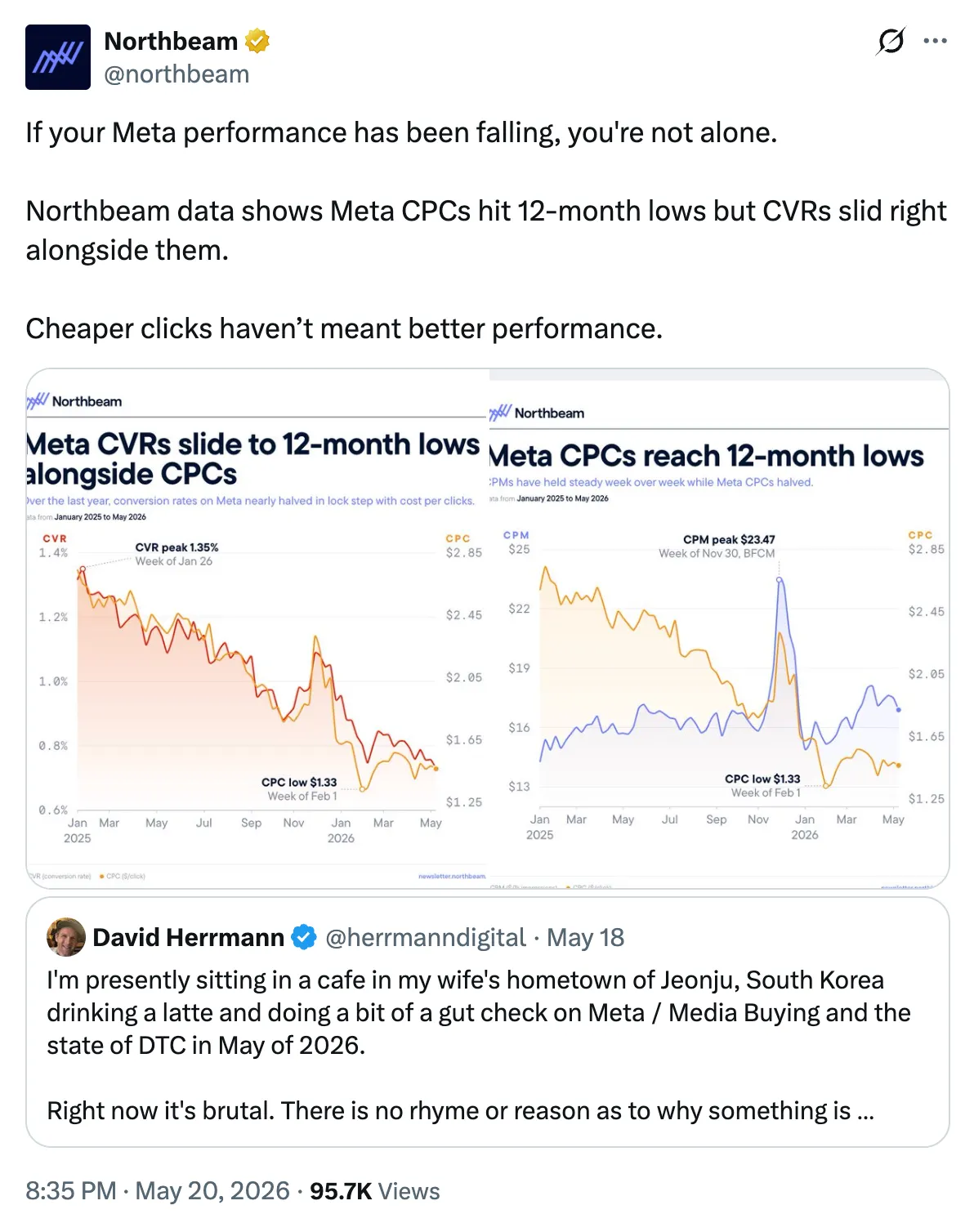
That was us in early 2026. Our Meta account was running pretty clean by the standard metrics. CPMs, CPCs, click-through rates, frequencies, all in healthy ranges. The platform-level numbers were fine.
The problem was the CPA. It was higher than we wanted and we needed it lower. Every expert we talked to pointed at the same set of levers, all inside the ad account.
We tried them. None of them moved the number meaningfully.
The funnel math
Round numbers below to keep the math simple. These aren't our actual figures, but the trend is what we experienced at Groove.
Spend 100 dollars at a 1-dollar CPC, you get 100 sessions on the site. From those sessions:
- 3 added to cart
- 2 initiated checkout
- 1 purchased
That's about a 1 percent conversion rate and the CPA lands around 100 dollars.
The conventional advice path was to grind CPC down. Test more creative, more audiences, more exclusions, more whatever. Let's say you did all that and got CPC to 90 cents. Now 100 dollars buys you 110 sessions instead of 100. The funnel ratio stays the same. You still get 3 add-to-cart, 2 initiate checkout, 1 purchase. Maybe at scale you see a 10 percent relative improvement somewhere, but you've been testing for months to get there and it's fragile.
That's the trap most teams are stuck in. They're attacking a part of the funnel where the room for improvement is small, the work is endless, and the gains evaporate as soon as Meta changes something.
What actually worked
We rebuilt our product pages from scratch.
Not A/B testing a button color or changing a headline. We scrapped the existing pages and built new ones. We looked at other sites that we felt were doing a great job selling their product, broke down what they were doing, and reverse engineered the approach for our category.
Same illustrative math, new numbers on the same 100 sessions:
- 6 added to cart
- 4 initiated checkout
- 2 purchased
The only ratio that changed was add to cart rate. The rest of the funnel pre-add to cart and post-add to cart had the exact same performance.
The outcome? A 50 dollar CPA instead of 100 dollars. Your performance doubled and you didn't touch your ad account.
The part nobody focuses on
Most teams live inside the ad platform. They open Ads Manager every day, look at frequency, check creative performance, restructure budgets. The site is something owned by another team and is assumed to have it's own testing schedule that's independent of paid traffic. That's backward.
The add-to-cart rate is the one number you have the most direct control over. You can rewrite the page next week, change the offer architecture, rebuild the social proof, the imagery, the copy hierarchy, the comparison table. None of that requires you to wait for the ad platform to give you anything.
Compare that to ad optimization, where you're at the mercy of an algorithm you don't control and a market full of other bidders doing the same thing you are. The on-site experience is the lever you actually own.
The dating analogy
Think about it like an online dating profile. You can put all the right information on it. Six foot, fit, smart, rich, accomplished, and let's assume it's all true. The profile generates matches. You go on the date.
Then you show up dirty, didn't shower, smell bad, and didn't brush your hair. The date doesn't go well, so you don't get a second one. But instead of showering, you assume it's your dating profile and sit there trying to figure out how to get more first dates.
That's most brands with traffic and a bad product page. You don't need more matches, you just need to show up better when they arrive.
The hard part is that we go blind to our own sites. When you look at a competitor's product page, you see every mistake instantly. The hero shot is off, the offer isn't clear, the social proof is buried, the copy is weak. When you look at your own page, you miss all of it because you've stared at it for so long.
The bigger lesson
You don't necessarily need more traffic to hit your number. You don't necessarily need more traffic to grow.
You probably need to show up better with the traffic you already have.
This isn't true for every business. If you don't have traffic, none of this applies. But if you've been running paid acquisition for a while and your funnel ratios feel stuck, the next gain is usually waiting on your site, not in your ad account.
P.S. Quick exercise:
Pull your add-to-cart rate, initiate-checkout rate, and purchase rate over the last 90 days. Then read your product page end to end as a customer would, and read two or three competitors' pages the same way.
Ask yourself one question: if I'd never seen my own product page before today, what would I think is wrong with it?
That's where your next round of CPA reduction is hiding.