Beginners and experts make decisions in similar ways
Beginners and experts make decisions in similar ways. The decisions are simple, and the underpinnings don't matter much, they might trust their gut or they might just move quickly, but the difference is what they're using to decide, because a beginner and an expert can land on the same simple call and get very different results.
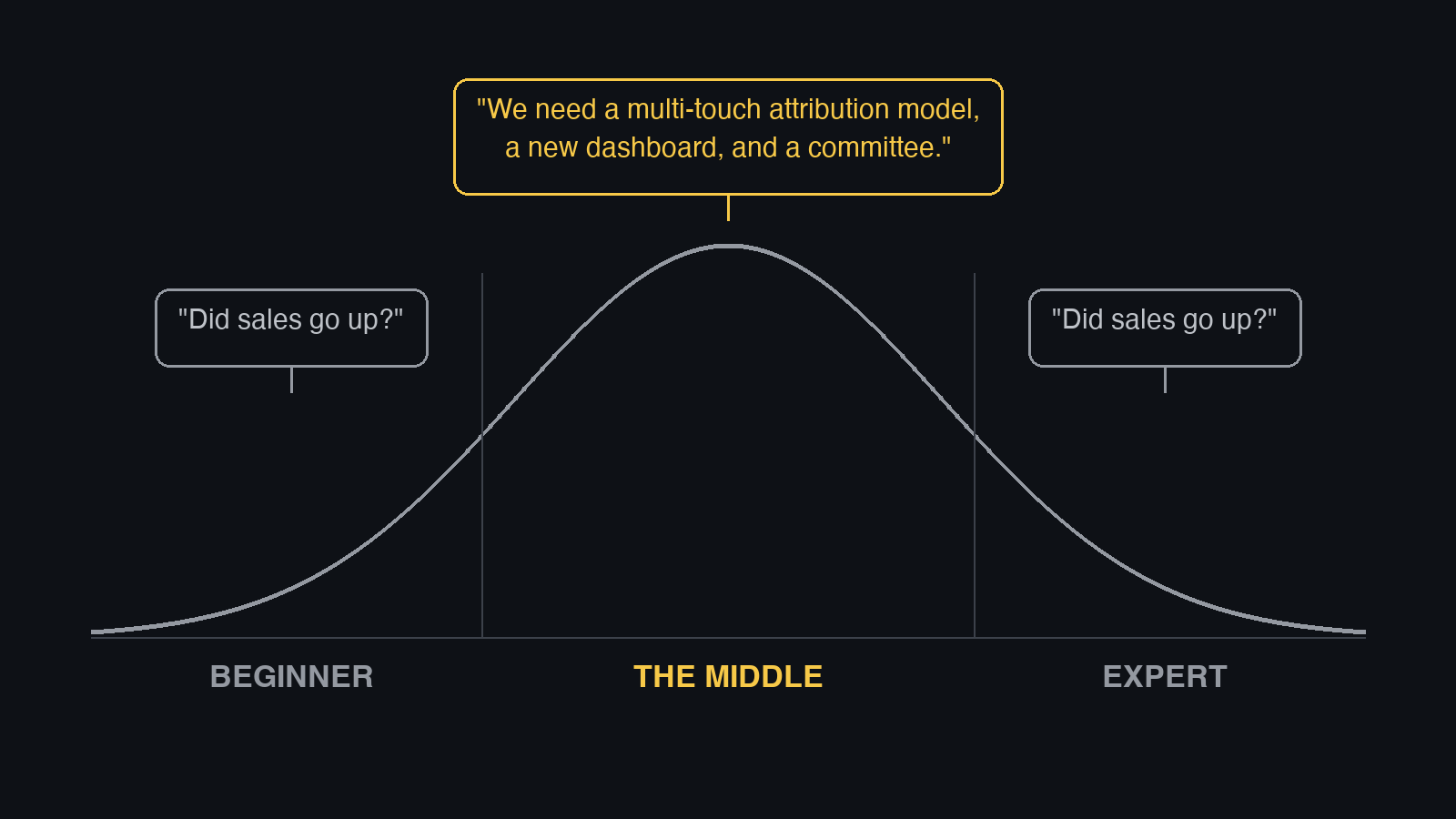
Take the endless question of attribution. Everybody wants to know attribution, we've all spent tons of money trying to find it, and beginners don't know that it's a thing while experts know that it's not the end-all be-all. It's the group in the middle that spends endless hours building the spreadsheets and the models.
The middle
In between the two tails sits the middle, and it basically needs the data, the tools, the resources to make a decision, or it hands the decision off entirely, to a person or a tool. They're not comfortable making decisions, and the decision they've cornered themselves into is so complex... I don't blame them.
Each group has a downside, beginners make bad decisions, experts are hard to replicate, and the middle doesn't make decisions at all. Being stuck there looks like committees, not having clear ownership of outcomes, waiting for more data, another dashboard, or someone else to make the decision.
The middle is a season
The middle gets a bad rap, and I don't think it deserves all of it, because it's a necessary stage on the journey to mastery. It's also a trap you can settle into. You're going to pass through it in every category of your business and in everything else you pursue, overcomplicating things, second-guessing things, and that's part of the journey, so there's nothing wrong with being in that season. At some point, though, you need to get through it and move with clarity.
How do you know you're through? I think it's when you make simple decisions and the outcomes are good, that's a good indicator that maybe you've reached mastery, and if you're making simple decisions and they're still bad, maybe you haven't gotten it yet. Another filter is whether you can explain it to someone who isn't an expert.
The way through
It's repetition and ownership. Owning outcomes, seeing things front to back, being forced to decide, those are all key elements of the progression, and I'm always fascinated by the way people's thinking and behavior changes as they're exposed to more things, because the exposure comes from those two places. Without ownership you're a passive observer, with ownership you're an active participant.
Some people are naturally driven or inclined to push through, and others aren't, and if you lead a team, the question is how you encourage people to get there too. I would posit that people are able to achieve more than what's expected of them once they see what is possible, and seeing what's possible is the hard part, it's very hard to do on your own, and it's a lot easier when somebody ahead of you is showing you.